
Architecting Agentic Payment Flows: System Design Insights from TCS
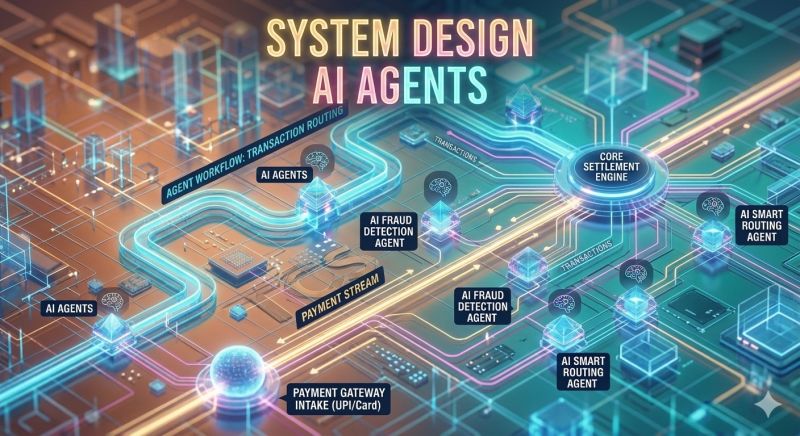
My recent three-month tenure at Tata Consultancy Services (TCS) provided a unique vantage point into the lifecycle of early-stage innovation. Unlike traditional development roles, this internship focused on architecture, feasibility research, and the exploration of emerging tech ecosystems.
Architecting the Agent Farm Ecosystem
A significant portion of my work centered on the agent farm ecosystem, a space where autonomous agents interact within a controlled environment. My role involved bridging the gap between existing payment infrastructures and these agentic systems.- Designing system components for an integrated payment gateway.
- Modeling transaction flows specifically tailored for autonomous agents.
- Evaluating security considerations and behavioral protocols for machine-to-machine payments.
Enabling Agentic Payment Flows
One of the most compelling challenges was enabling two-way agentic payment flows. This required a deep dive into how financial infrastructure can be automated to support agents operating independently. By connecting standard payment rails with agent-based architectures, we were able to evaluate the practicalities of autonomous commerce within a controlled architecture.Research Engineering and System Design
This experience sat firmly at the intersection of research engineering and system design. The focus was rarely on routine development; instead, the work prioritized: - Evaluating the technical feasibility of emerging concepts. - Shaping the high-level architecture of innovative platforms. - Translating theoretical technologies into functional, real-world systems through rigorous systems thinking.This journey of exploration was supported by the guidance of my mentor, Nita Khare, and the collaboration of colleagues Aadil Rayeen and Diya Manapetty. These three months have served as a vital foundation for understanding how autonomous systems will shape the future of digital transactions.