Scaling Physical AI: Cross-Embodiment Navigation with NavDP and Isaac Sim
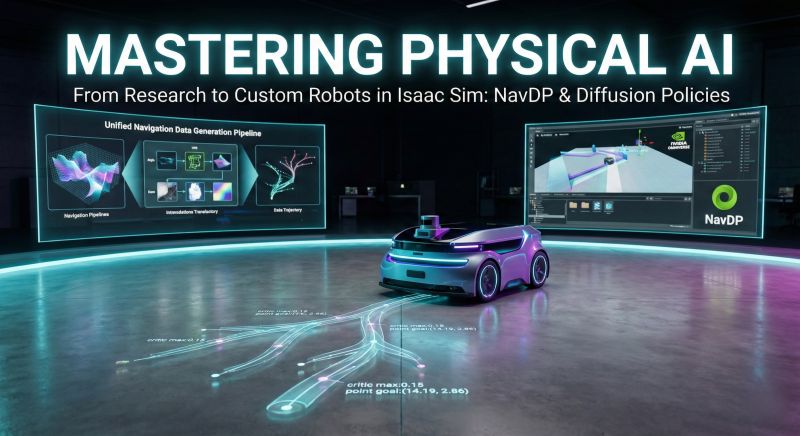
The transition from traditional vision models to Vision-Language-Action (VLA) architectures marks a significant shift in the field of Embodied AI. Mastering this stack requires bridging the gap between theoretical research logic and high-fidelity simulation environments. A standout advancement in this space is NavDP (Navigation Diffusion Policy), a unified framework designed for cross-embodiment navigation without the need for real-world training data.
Technical Architecture: How NavDP Works
Unlike standard navigation stacks, NavDP utilizes a data generation pipeline that distinguishes between "accessible" and "prohibited" zones based on a robot’s specific physical dimensions.
* Embodiment-Aware Planning: Traditional policies often overfit to specific hardware. NavDP circumvents this by generating cost maps that respect the robot's footprint, ensuring the pathing is feasible for the specific platform.
* The Diffusion-Critic Loop: At the heart of the framework is a diffusion process that generates a distribution of potential trajectories. This is managed through Dual Supervision.
* Action vs. Critic Supervision: The model is trained with Action Supervision to suggest paths and Critic Supervision to evaluate safety. This allows the system to generate a trajectory and then filter it, selecting the safest route that respects the robot’s kinematics and obstacle constraints.
Implementation: Simulating the Lekiwi Robot
To validate the robustness of the NavDP framework, I integrated the Lekiwi a low-cost, 3-wheel holonomic base into the system within NVIDIA Isaac Sim, replacing the default Dingo robot assets.
Testing the "Zero-Shot" transfer capabilities of a research paper requires moving beyond default configurations. This integration presented several engineering challenges:
* Asset Integration: Refining URDFs, managing rigid body physics, and ensuring precise RGB-D sensor alignment.
* Generalization Testing: Verifying if the policy could handle a completely different kinematic chain (Lekiwi's omni-wheels) compared to the original training environment.
Engineering Insights
Bridging the gap between a research paper and a functional simulation is where real engineering growth occurs. The Unified Navigation Data Generation Pipeline developed by the team at Intern Labs (Shanghai AI Laboratory) represents a major step forward for Sim-to-Real applications. When combined with the high-fidelity physics of NVIDIA Omniverse, it provides a powerful sandbox for developing generalized embodied agents that can navigate diverse environments regardless of their physical configuration.
For those interested in the underlying mechanics, the research and source code provide a robust foundation for further experimentation in the embodied AI space.